Cleanliness Inspector
CIX100

Turnkey Solution for Technical Cleanliness Inspection

CIX100: Reliable Turnkey Solution

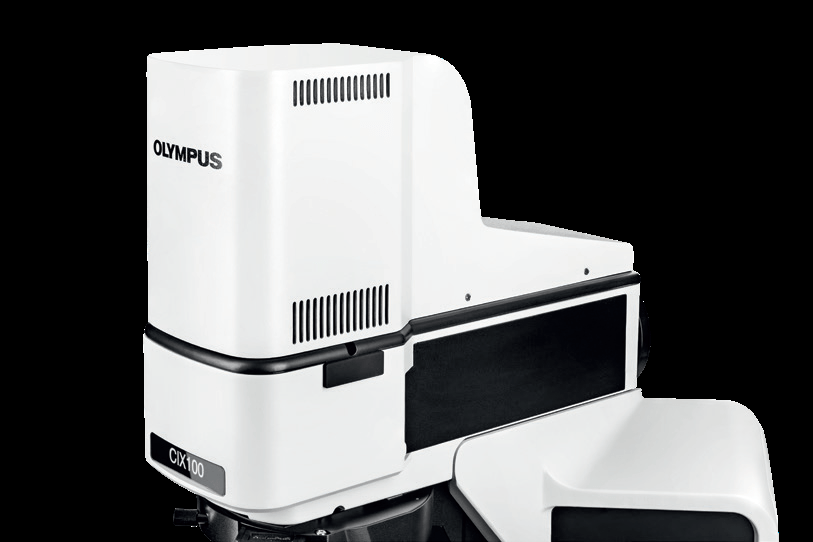
The CIX100 system is a turnkey solution designed to meet the needs of automated cleanliness inspection. Each component is optimized for accuracy, reproducibility, repeatability, and seamless integration for reliable data in a high-throughput system. The system provides excellent optical performance for fast inspections of circular and rectangular inspection areas. Automation of critical tasks helps speed up inspections while minimizing human errors and the risk of contaminating the sample.

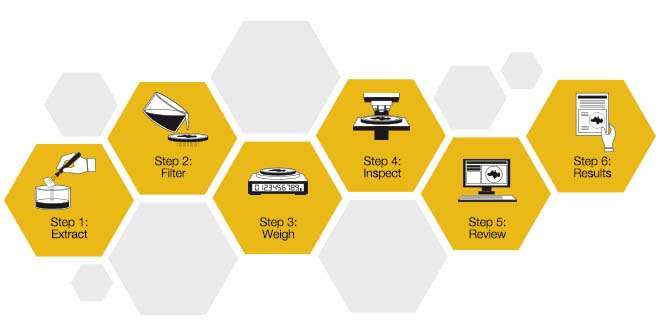
CIX100: Simplify Your Technical Cleanliness

The cleanliness of components, parts, and fluids is at the center of the manufacturing process. Meeting high standards for counting, analyzing, and classifying the often micron-sized contaminant and foreign particles is important for:

  • Development
  • Manufacturing
  • Production
  • Quality control of the final product

CIX100: Efficient Data Evaluation

Revise inspection data with powerful and easy-to-use tools that support company and international standards for cleanliness inspection. Clear representation of all relevant inspection results saves time.

  • Organized arrangement of images and data for efficient data review
  • Various selectable views for immediate particle identification
  • Particle locations and thumbnails are linked to the live images
  • Easy reclassification, review, revision, and recalculation of inspection data
  • Live display of the overall cleanliness code, particles, and classification tables
  • Trend analysis to identify potential measurement deviations over time
  • Display the complete inspection data in one view

CIX100: Fast Live Analysis

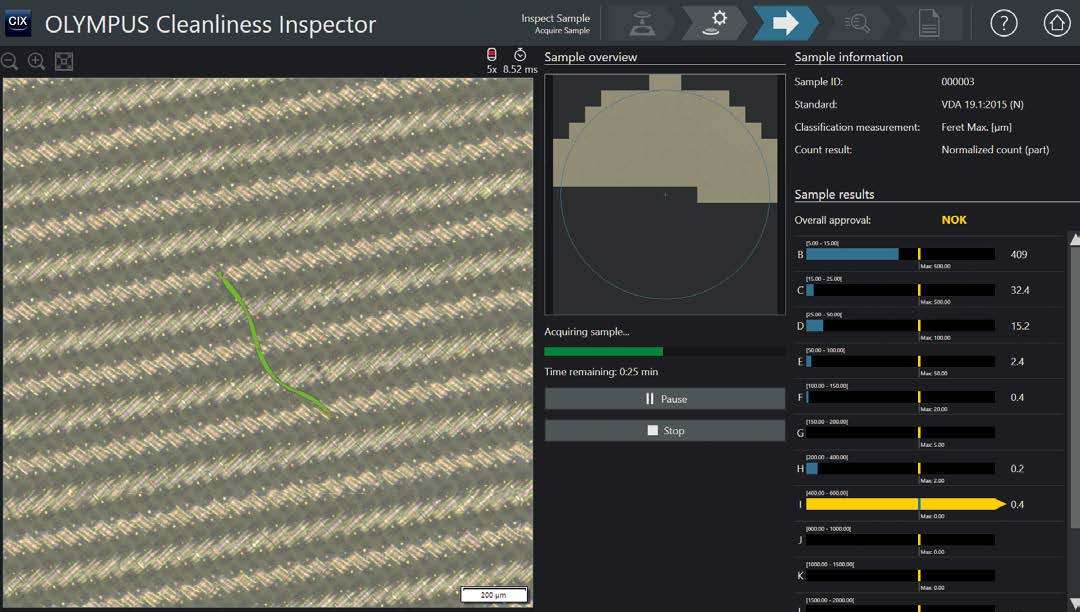
The innovative all-in-one-scan solution detects reflective (metallic) and non-reflective particles twice as fast as conventional methods that require two separate images. Immediate feedback of counted and sorted particles helps you make fast decisions.

  • Overview image for fast identification of filter coverage, particle clustering, or worst particles
  • Automatic live processing and classification of contaminant particles ranging from 2.5 μm up to 42 mm
  • High throughput: system detects reflective and non-reflective particles in one scan
  • Live analytics enable you to react to the results in real time
  • Compliant results are customized to the selected industry standards

Excellent Optical Quality, Mechanical Stability, and Security
Excellent Optical Quality
Our UIS2 objectives provide high optical performance for excellent measurement and analysis accuracy. A dedicated light source maintains a consistent color temperature optimized for cleanliness inspection.
Optimized Reproducibility
The preconfigured and pre-calibrated system has reminders for automatic system self-checks with the integrated calibration slide that helps maintain regular system verification.
Stable Measurement System
The optical path alignment, motorized nosepiece, and the camera are protected by a cover to prevent accidental modifications. For greater stability, all moving parts have been eliminated from the optical light path.
Sample Holders for Greater System Versatility

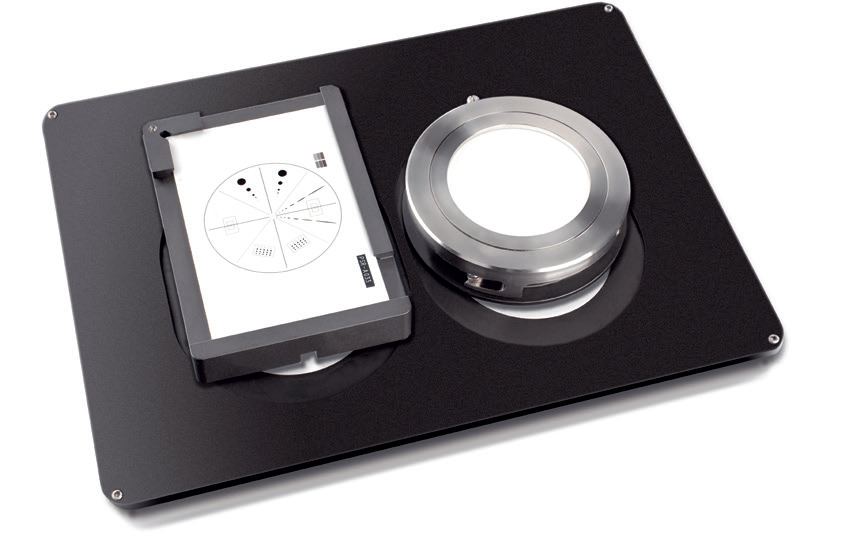
The CIX100 system supports various sample holders with either circular or rectangular inspection areas. This includes holders with white or black backgrounds for filter membranes with a diameter of 25 mm, 47 mm, and 55 mm; holders for tape lift sampling; holders with a flat surface for metallurgy applications; and holders for particle traps.
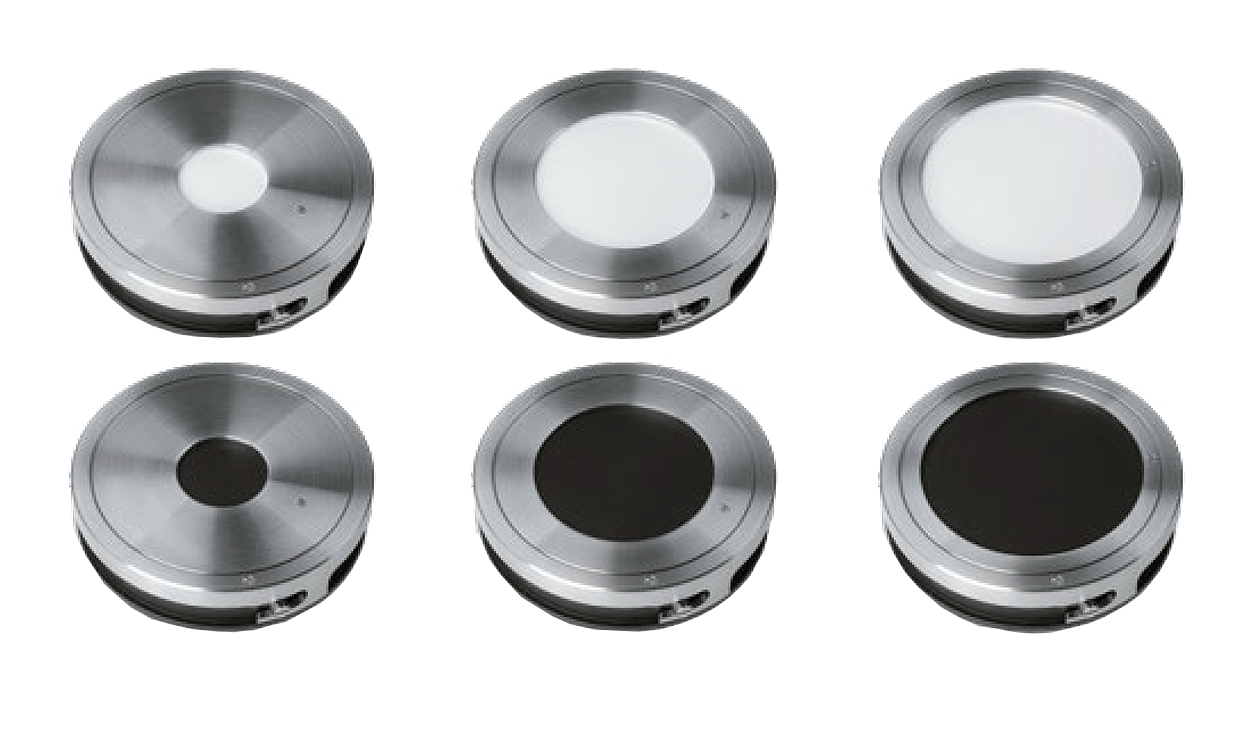
Circular sample holders with white and black backgrounds

For filter membranes with diameters of 25 mm (left), 47 mm (middle), and 55 mm (right).

Sample holder for particle traps


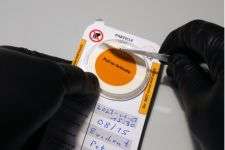
Sample holder for tape lift sampling


Fast Live Analytics and Review All Relevant Data Displayed in One Place

The CIX100 system offers high-performance image acquisition and precise live analytics of both reflective and non-reflective particles ranging from 2.5 μm up to 42 mm in a single scan thanks to a patented* polarization method. This all-in-one-scan solution enables scans to be completed twice as fast as the classical method (Inspector series). Counted and sorted particles are displayed live and sorted into size classes while the scan is acquired, supporting direct decision making and helping ensure a fast reaction time in case of a failed test.

All relevant data are displayed live on a single screen during the inspection, enabling the operator to stop or interrupt the inspection if a test fails.

Capture Data In A Single Scan

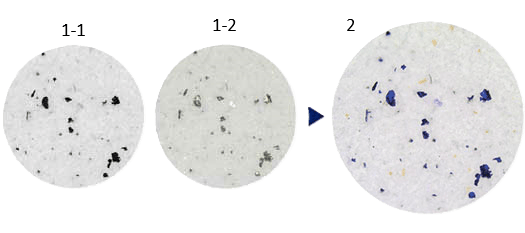
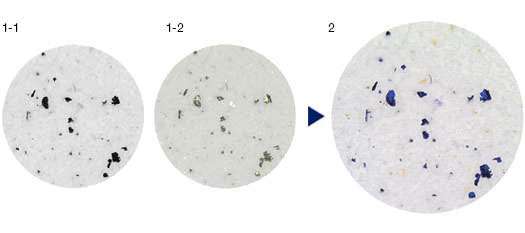
An innovative polarization method based on wavelength separation and color detects both reflective (metallic) and non-reflective particles in a single scan. Integrated into the microscope frame, this high-throughput design enables scans to be completed twice as fast as the classical method (Inspector series) and eliminates moving components from the optical light path, such as the polarizer, which could negatively impact the system stability, leading to potentially incorrect results. This all-in-one-scan technique increases the number of inspected particles, reducing the cost per test and shortening the reaction time in case of a failed test.


1: Classical method, 2: Single-scan method
(1-1: First image of non-reflecting particles, 1-2: Second image of reflecting particles, 2: Single-scan solution: Combined)
An innovative polarization method detects both reflective (metallic) and non-reflective particles in a single scan.
Review Particles in Real Color

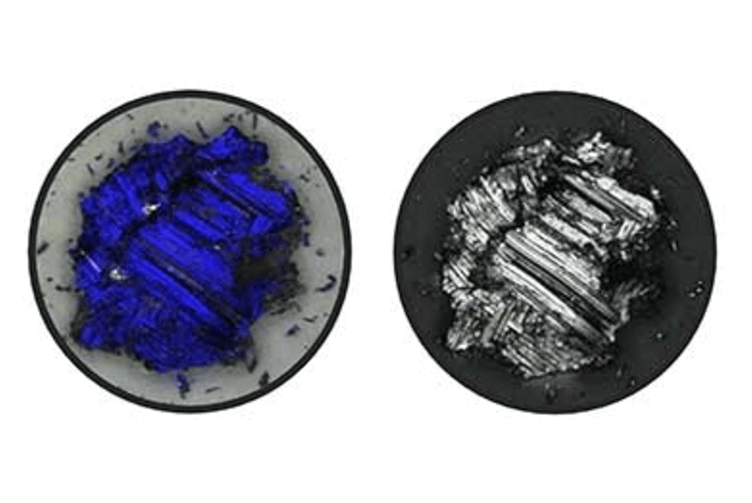
Activating real color mode enables users to view particles in their actual colors, providing additional information to identify the particle type as metallic or non-metallic.

The all-in-one scan shows all reflective particles as blue in polarization, indicating these particles are metallic. In real color mode, the blue color of reflective particles is omitted, and the true colors of all particles are shown in the brightfield image. Materials that are actually blue remain blue, while metals show their metallic shine and the reflections typical for the material.

With these helpful visuals, users can better understand the nature of each particle and quickly confirm the particle type.

LEFT Image: Particle as seen by the system during detection and analysis. The blue color indicates that this particle is metallic.

RIGHT Image: The same particle as seen during the review mode in real color using the U-ANT filter and the color correction mode. The particle is confirmed as metallic.

Deep Data Insights for Direct Identification
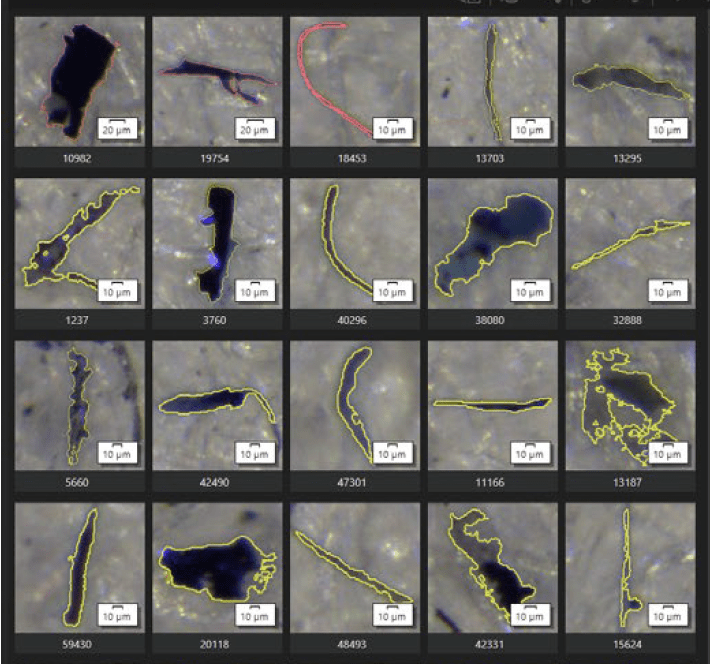
Clear arrangement of images, data and results for immediate decision making for reprocessing. At-a-glance display of complete inspection data in various selectable views. View images of particles organized from largest to smallest for all kind of particles (reflective or non-reflective).

RIGHT image: Visualization of different particle view e.g., the largest reflective or non-reflective particles.
SUPPORTED STANDARDS
Evaluation is performed according to all major international standards used in the automotive and aerospace industries, including:

ASTM E1216-11:2016
ISO 4406:2021
ISO 4407:1999
ISO 4407:2002 [Cumulative and Differential]
ISO 11218:2017
ISO 12345:2013
ISO 14952:2003
ISO 16232-10:2007 (A, N, and V)
ISO 16232:2018 (A, N, and V)
ISO 21018:2008
DIN 51455:2020 [70%and 85%]
NAS 1638:1964; NF E 48-651:1986
NF E 48-655:1989
SAE AS4059:2020
VDA 19.1:2015 (A, N, and V)
VDA 19.2:2015

Companies also have the flexibility to set up their own evaluation standards. Reports can be easily modified to meet the needs of your company.
Efficient Report Creation
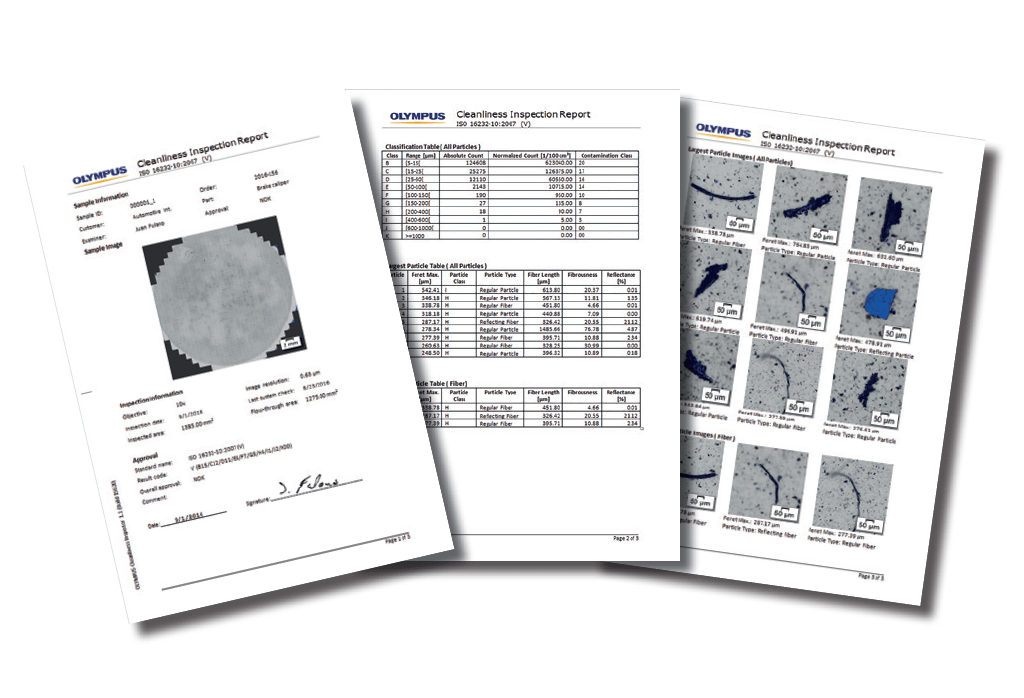
Reports that comply with international standards
Sample Information Area
This area of the report consists of information about the sample such as customer, examiner, order number, and date of inspection. All data are inserted automatically.
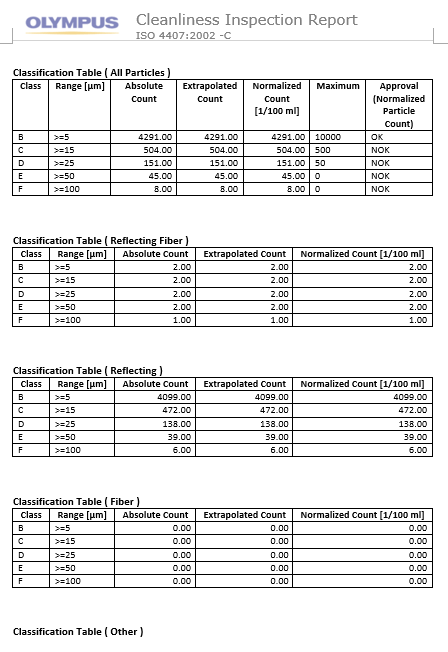
Classification Table
This section of the report incorporates the data calculated during the inspection according to the standard used and displays information such as size class and range information, as well as the absolute numbers of particles detected and the contamination class.
Images of the largest particles
Thumbnails of the largest particles are displayed together with the particle parameters and the particle class. Thumbnails can also show images of contaminants reconstructed by stitching smaller images together.
Easy Data Export
Exporting a report is as easy as clicking your mouse. Create the reports in Microsoft Word or PDF format, depending on your preference, and easily export the particle and classification results and trend analysis to Microsoft Excel. Report file sizes are optimized for efficient data sharing

Hardware

Microscope CIX100 Motorized focus
  • Coaxial motorized fine focus with 3-axis joystick
  • Focus stroke: 25 mm
  • Fine stroke: 100 µm / rotation
  • Maximum height of stage holder mounting: 40 mm
  • Focus speed: 200 µm/sec
  • Software autofocus enabled
  • Customizable multipoint focus map
Illumination
  • Built-in LED illumination
  • Innovative illumination mechanism with simultaneous detection of reflecting and non-reflecting particles
  • Light intensity controllable by software
Imaging device
  • Color CMOS USB 3.0 camera
  • On chip pixel size 2.2 × 2.2 µm
Sample size
  • The standard sample is a filter membrane with a diameter of 47 mm; filter holders with a 25 mm or 55 mm membrane diameter or customized sample holders are available
Nosepiece Motorized type Motorized nosepiece
  • Six-position motorized nosepiece with three preinstalled UIS2 objectives
  • PLAPON 1.25X used for preview
  • MPLFLN 5X used for detecting particles bigger than 10 µm
  • MPLFLN 10X used for detecting particles bigger than 2.5 µm
Software controlled
  • The image magnification and relationship between pixel and size is known at every moment
  • Selected objectives are used at selected steps in the measurement process, and the objectives are automatically positioned
Stage Motorized stage X,Y Motorized stage X,Y
  • Stepper motors controlled movement
  • Maximum range: 130 × 79 mm
  • Max speed: 240 mm/s (4 mm ball screw pitch)
  • Repeatability: < 1 µm
  • Resolution: 0.01 µm
  • Controllable with a three-axis joystick
Software controlled
  • Scanning speed depends on the used magnification; at 10x the scanning time is less than 10 minutes
  • Stage alignment is performed during factory assembly
Specimen holder Sample holder
  • Membrane holder is specially designed to avoid an unwanted rotation of the membrane during the mounting
  • The membrane is mechanically flattened by the membrane holder
  • No tool is needed to fix the cover
  • Sample holder for filter membranes with diameters of 25 mm, 47 mm, and 55 mm
  • Sample holder for particle traps, particle trap consumables, and tape lift samples
Particle standard device (PSD)
  • Reference sample used to validate the system measurement
  • Sample used in the check system's built-in function for controlling the proper function of the CIX100
  • The PSD is always assigned slot 2 on the stage
Stage insert Two-position stage insert
  • Stage insert dedicated to the correct positioning of the sample holder and the PSD
Controller Workstation High-performance pre-installed workstation
  • HP Z4G4, Windows 10, 64-bit Professional (English)
  • 16 GB RAM, 256 GB SSD, and 4 TB data storage
  • 2 GB video adapter
  • Microsoft Office 2019 (English) installed
  • Networking capabilities, English qwerty keyboard, optical mouse 1000 dpi
Add-in boards
  • Motorized controller, RS232 seria,l and USB 3.0
Language selection
  • Operating system and Microsoft Office default language can be changed by the user
Touch panel display 23-inch slim screen
  • Resolution 11920×1080 optimized for use with the CIX software
Power Rating
  • AC adapter (2), controller and microscope frame (4 plugs necessary)
  • Input: 100–240 V AC 50/60 Hz, 10 A
Power consumption
  • Controller: 700 W; monitor: 56 W; microscope: 5.8 W; control box 7.4 W
  • Total: 769.2 W
Drawing Dimensions (W × D × H) Approx. 1300 mm × 800 mm × 510 mm (51.2 in. × 31.5 in. × 20.1 in.)
Weight 44 kg (97 lb)
Normal use Temperature 10 °C to 35 °C (50 °F to 95 °F)  
Humidity 30 to 80%
For safety regulations Environment Indoor use
Temperature 5 ℃ to 40 ℃ (41 °F to 104 °F)
Humidity
  • Maximum 80% (up to 31 °C [88 °F])
    (no condensation)
  • Usable humidity declines linearly as temperature rises above 31 °C (88 °F)
  • 70% (34 °C [93 °F]) to 60% (37 °C [98 °F]) to 50% (40 °C [104 °F]) 
Altitude Up to 2,000 m (6,562 ft)  
Level of horizon Up to ±2°
Power supply and voltage stability  ±10%
Pollution level (IEC60664) 2
Overall voltage category (IEC60664) II
Software CIX-ASW-V1.6
  • Dedicated workflow software for technical cleanliness inspection
Languages GUI
  • GUI: English, French, German, Spanish, Japanese, Simplified Chinese, and Korean
Online help
  • Online help: English, French, German, Spanish, Japanese, Simplified Chinese, and Korean
License management
  • Software license activated by license card (already activated at installation)
User management
  • System can be connected to a network for domain administration
  • The range of functions can be selected depending on the authenticated user.
Live image Display in color mode
  • Metal particles are shown as blue and nonmetallic particles in their natural color
Window fit method
  • The image is always displayed in a full view
Live detection
  • Particles are detected as soon as they are captured for improved speed 
  • User can stop the process if the measurement result is not good
Live classification
  • Particles are classified as soon as they are detected
  • Particle size classes are identified on the user interface during the live acquisition
Microscope mode
  • Microscope mode can be accessed for microscopic imaging
  • Optional access to material analysis solutions (not included)
Image capture and manual measurements Collecting user snapshots
  • In the review mode it is possible to acquire single images from any position on the sample, as well as acquire images in the live observation mode (from direct image) or the sample view mode (from recorded data)
  • Images can be stored in .tif, .jpg, or .png files with a standard resolution of 1000 × 1000 pixels
  • Snapshots can be linked to detected particle and used in the analytical report afterwards
  • Particle snapshots can be automatically acquired in EFI (extended focus imaging) mode
  • Recordings taken in EFI mode can be used in the analytical report
Manual measurements
  • It is possible to perform arbitrary distance measurements on an acquired snapshot
  • Arbitrary measurements can be renamed, and the color can be colored
  • Arbitrary measurements and a scale bar are saved in the image when stored
Hardware control XY motorized stage
  • Joystick operation and control by software
  • Inspection of circular and rectangular sample areas
  • Automatic or manual repositioning on selected particles
Motorized nosepiece
  • Selection by software only
Motorized focusing
  • Control by joystick
  • Software autofocus available
  • Predictive autofocus using multipoint focus map
Check system System verification
  • System is verified by measuring the particle standard device parameters
  • OK or NOK quality value is produced
Selectable objective
  • Check system can be performed only with the working objective (one objective should be selected at least)
  • Check system is performed with either 5X or 10X objectives (or both)
Technical cleanliness standards Supported standards
  • ASTM E1216-11:2016; ISO 4406:2021; ISO 4407:1999; ISO 4407:2002 [Cumulative and Differential]; ISO 11218:2017; ISO 12345:2013; ISO 14952:2003; ISO 16232-10:2007 (A, N, and V); ISO 16232:2018 (A, N, and V); ISO 21018:2008; DIN 51455:2020 [70%and 85%]; NAS 1638:1964; NF E 48-651:1986; NF E 48-655:1989; SAE AS4059:2020; VDA 19.1:2015 (A, N, and V); VDA 19.2:2015; VDI 2083-21
Precisely compliant to VDA19:2016 recommendations
  • Thresholds are automatically set at the VDA recommend values
Identification of particle family
  • Particles can be classified by particle families (fibers, reflecting, reflecting fibers, or others)
  • Possibility to discriminate the detected particles in terms of particle type based on AI
Customized standards
  • User-defined standards can be easily defined
  • Particle measurement parameters include filiform particle size and compact particle size according to DT 55-83
Inspection configuration
  • The system enables users to load, define, copy, rename, delete, and save an inspection configuration
  • Standards and report templates can also be stored and recalled
  • It is possible to invert the detection threshold to detect bright particles on a dark background
  • It is possible to acquire several samples in a sequence
  • It is possible to set approval limits for individual particle types
  • It is possible to extend contamination class codes (CCCs) for the different particle types
  • Each sample can be inspected with a particular configuration
Particle tile view Displays the detected particles in tile for improved navigation
  • Every particle position can be retrieved by double clicking on the tile
  • Each tile is adapted to the actual particle size
Store the full membrane The complete filter is stored
  • Offline analysis enables users to select a different standard for the results display
Data export Save data
  • Inspection data can be exported to an Excel (.xlsx) table
  • All tables available in the software can also be exported into Excel
Trend analysis Trend analysis over several samples (built-in SQC tool)
  • Data per size classes can be displayed
  • Data can be plotted over time, sample, and measurement ID
  • Scale can be selected (log-normal, log-log)
  • Data points can be extracted and exported to a spreadsheet
  • Table can be exported in Q-DAS (.dfq) format; all tables available in the software can also be exported into Excel
Particle editing Particles can be edited during the revision process. 

It is possible to:

  • Add, delete, merge, or split particles with lines or a polyline
  • Change the particle type
Dynamic reports Professional analytical reports can be produced using Microsoft Word 2019
  • Templates are customizable
  • Users can choose to put the pictures after the table or all pictures grouped together when selecting different particle families
Height Measurements Automatic or manual height measurement of selected particles
  • Optional software solution that drives the motorized focus drive from top to bottom of selected particles. The particle height is then processed from the difference between the top and the bottom Z coordinate.
  • Includes an additional objective lens (20X MPLFLN) and a license card that needs to be activated at installation.
  • It is possible to select multiple particles for automatic height measurement at several positions.
Europe Low Voltage Directive 2014/35/EU
EMC Directive 2014/30/EU
RoHS Directive 2011/65/EU
REACH Regulation No. 1907/2006
Packaging and Packaging Waste Directive 94/62/EC
WEEE Directive 2012/19/EU
Machinery Directive 2006/42/EC
USA UL 61010-1:2010 Edition 3
FCC 47 CFR Part15 SubPartB
Canada CAN/CSA-C22.2 (No. 61010-1-12)
Australia Radio communications Act 1992, Telecommunications Act 1997
Regulation on Energy conservation AS/NZS 4665-2005
Japan Electrical Appliances and Material Safety Act (PSE)
Korea Electrical Appliances Safety Control Act
Regulation on Energy Efficiency Labeling and Standards
Regulations for EMC and Wireless Telecommunication (Notice 2913-5)
China China RoHS
China PL Law
Regulation for Manuals

Specification are subject to change without notice or obligation on the part of the manufacturer